History
Historical traces from El Quseir
18 August 2026
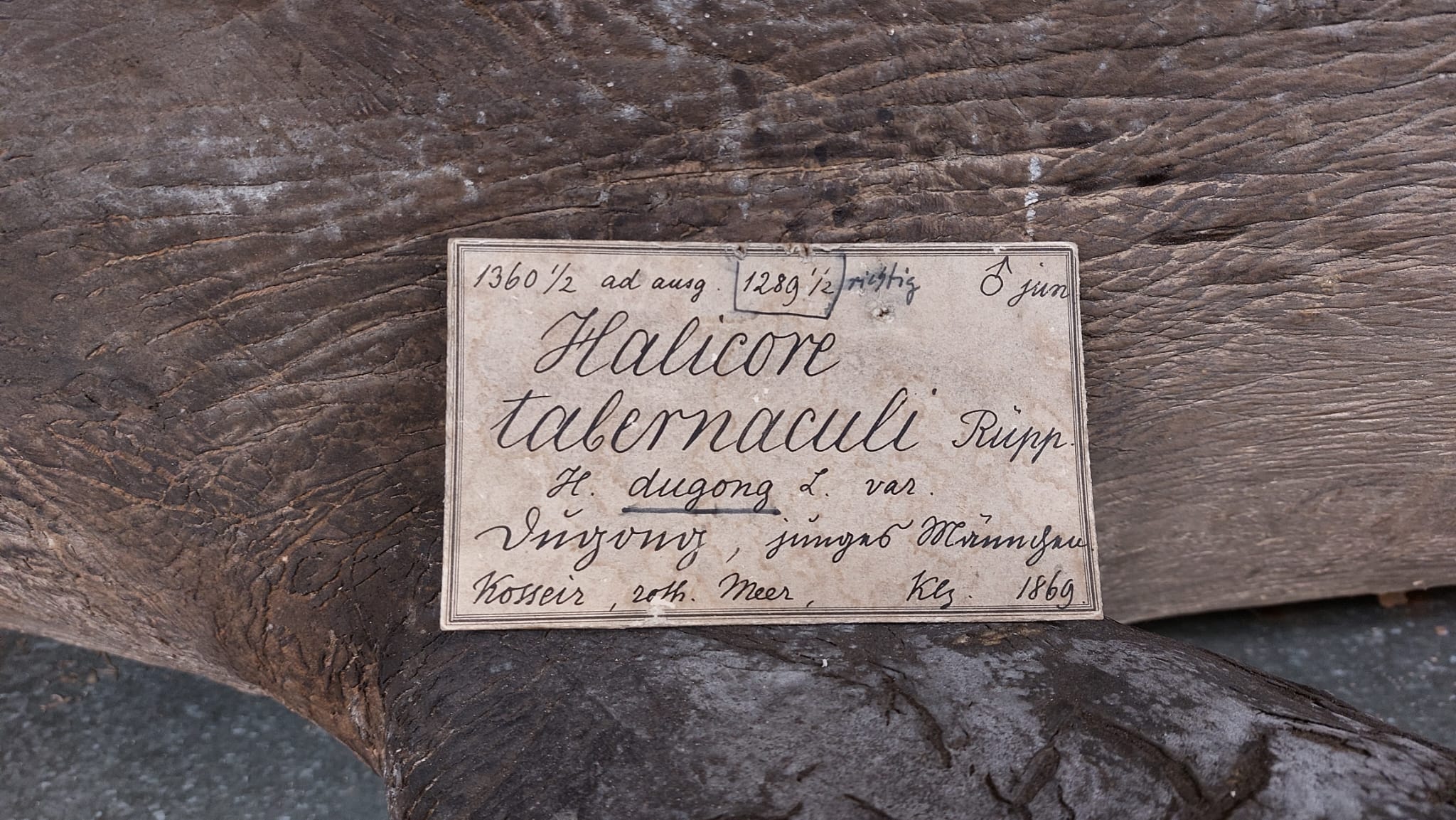
For DugongWatch, historical museum specimens provide valuable clues to the history of dugongs in the Red Sea.
19th-century dugong specimens lead back to the coast of El Quseir
In the 19th century it was common to send researchers and collectors to distant regions. There they collected animals and plants to bring them to Europe, study them scientifically and describe species that were still unknown. Many of these specimens ended up in the great European natural history museums, where they were presented to science and the public.
One of these researchers was Carl Benjamin Klunzinger (1834–1914), a physician and zoologist from Württemberg. From 1863 to 1869 and again from 1872 to 1875 he lived mainly as a doctor in El Quseir – then called Koseir – on the Egyptian Red Sea coast. From there he travelled the coastal region and the Nile valley and built up extensive zoological collections.
After returning to Germany, Klunzinger became curator at the Royal Natural History Cabinet in Stuttgart, today’s State Museum of Natural History Stuttgart. From 1884 to 1900 he also taught zoology, anthropology and hygiene as a professor at the Stuttgart Polytechnic, today’s University of Stuttgart.
Dugongs were among the animals Klunzinger searched for most intensively. He later described his efforts (quote translated from German):
“Among the mammals I collected, the sea maiden or Halicore dugong deserves special mention. From the day I left Europe, and in every letter afterwards, Prof. F. Krauss in Stuttgart urged me to look for dugongs. For a long time I could not obtain any. The reminders from home grew ever more pressing. Only when I offered a high reward (I believe 20 Maria Theresa thalers for the first specimen) did the Bedouin fishermen set to work with great zeal – and at last, in the fourth year of my stay, in the spring of 1868, I obtained six or more of these mighty whale-like animals in quick succession, complete with skin, flesh and bones.”
Several of the specimens he assembled, including dugongs from the Egyptian Red Sea coast, are still kept at the State Museum of Natural History Stuttgart today.
For DugongWatch these historical collections are of particular interest. They offer insights into the former distribution of the animals and – together with old reports, today’s observations and current photos and videos – can help us better understand the history of dugongs in the Red Sea.